Heavy Equipment Handling Solutions for Scaling Data Center Production
April 30, 2026
0
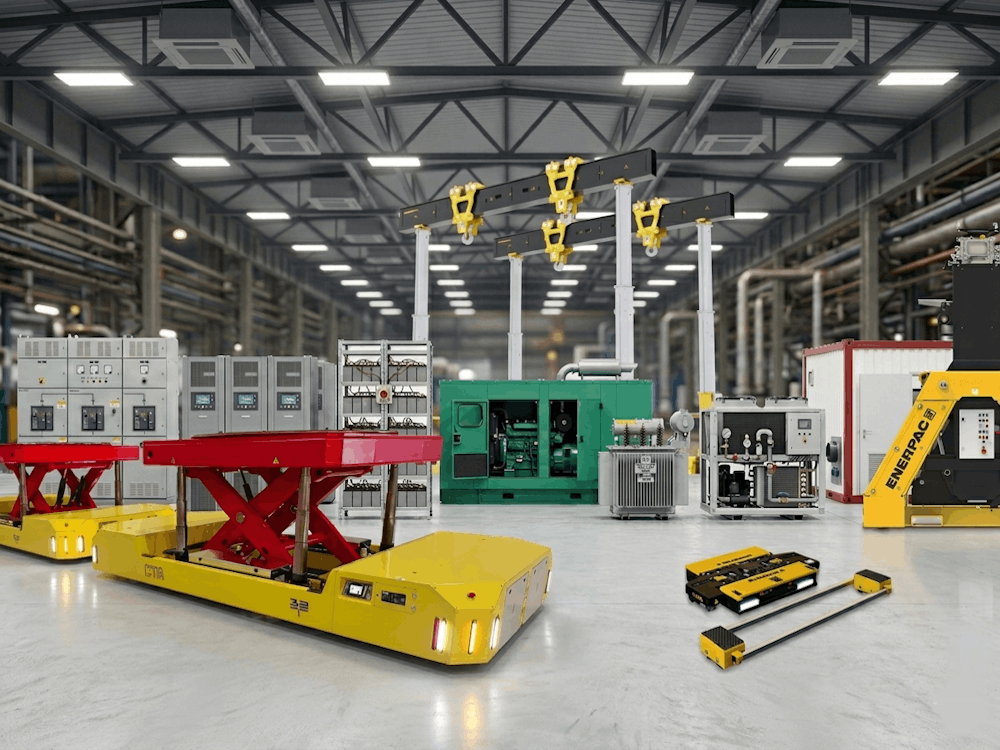
Using effective heavy-equipment handling solutions is becoming increasingly important due to the rapid expansion of data center infrastructure. This growth is placing significant pressure on manufacturers of critical components, including switchgear, uninterrupted power supply (UPS) cabinets, battery racks, generators, transformers, cooling skids, and modular enclosures.
As demand rises, many manufacturers need to overcome the problem of moving materials and heavy assemblies within the factory without creating delays, safety risks, or costly damage. This is where heavy equipment handling in manufacturing becomes a critical factor in scaling operations.
Where Bottlenecks Really Occur
In high-volume environments, bottlenecks are common between processes, where heavy materials and assemblies containing sensitive equipment need to be lifted, transported, and positioned. Moving a multi-ton UPS cabinet from assembly to testing, or positioning a transformer for final inspection can quickly become a limiting factor if the right industrial lifting systems are not in place.
As production scales, these challenges intensify and begin to impact throughput, safety, and overall efficiency.
Common Challenges in Moving Heavy Equipment in a Factory
1. Space Constraints and Oversized Loads
Many facilities were not designed for today’s data center components. As a result, manufacturers often struggle with:
- Moving oversized loads through restricted doorways and narrow aisles
- Limited turning space for long equipment such as cooling skids
- Congested production areas due to increased work-in-progress inventory
- Difficulty handling modular enclosures that require precise positioning
These constraints make handling oversized loads in manufacturing slow and complex, often requiring multiple adjustments that increase both time and risk.
2. Limited or No Overhead Lifting
A major issue across many facilities is the lack of suitable lifting infrastructure.
Manufacturers frequently face situations where they need lifting solutions without overhead cranes, especially in:
- Temporary production areas
- Areas with low ceilings
- Facilities with partial crane coverage
- Expansion zones not originally designed for heavy lifting
This creates dependence on limited crane availability or improvised solutions, both of which can lead to delays and safety concerns.
3. Floor Load Limits and Transport Restrictions
Heavy components such as transformers and generators introduce serious floor loading challenges.
Key issues include:
- Restrictions on where equipment can be moved or staged
- Inability to use conventional forklifts due to point load limits
- Risk of floor damage from concentrated weight
- The need for heavy-load transport systems that distribute weight evenly
Managing floor load limits in heavy equipment handling is essential to maintaining safe and continuous operations.
4. Stability and Precision Requirements
Many data center components are not only heavy but also sensitive to movement.
Manufacturers must manage:
- Vibration-sensitive systems and battery racks
- Tall or narrow loads with a high center of gravity
- Asymmetrical equipment
- Tight tolerances for aligning modular enclosures
This makes safe movement of heavy equipment in a plant a precision task, not just a lifting challenge.
5. Safety Risks and Manual Handling
Without the right lifting and transport equipment, operators are exposed to significant risks:
- Load instability during lifting or transport
- Crushing hazards during positioning
- Limited visibility when moving oversized equipment
- Fatigue from repeated manual handling adjustments
As production increases, these risks scale with it, making safety a critical concern.
6. Reducing Downtime
One of the biggest impacts is on productivity:
- Equipment waiting for available lifting resources
- Delays caused by complex or multi-step handling processes
- Repositioning and alignment slowing down workflows
- Damage leading to rework and missed deadlines
Even small inefficiencies in moving heavy equipment in a factory can create significant production bottlenecks.
Heavy Equipment Handling Solutions That Improve Throughput
To overcome these challenges, manufacturers are adopting advanced industrial lifting solutions that improve control, safety, and efficiency without requiring major facility changes.
Portable Hydraulic Gantries
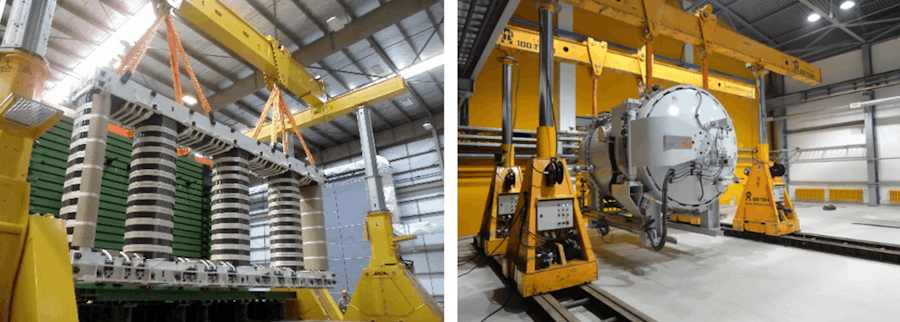
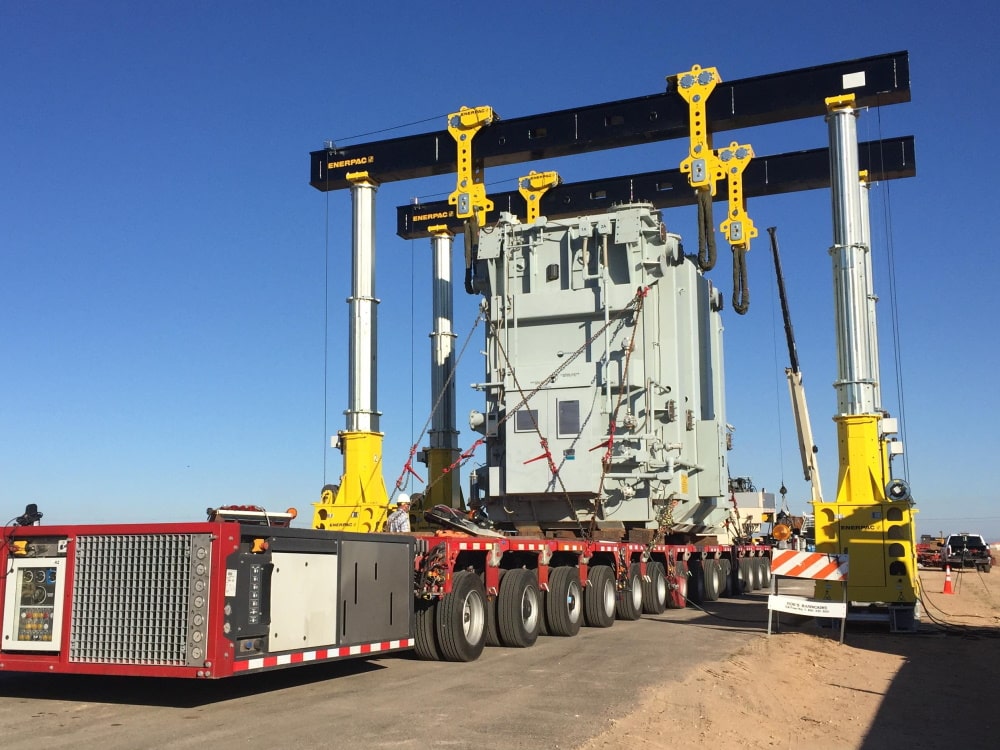
Portable gantries provide a flexible alternative to fixed cranes and are well-suited to environments where overhead lifting is unavailable or restricted.
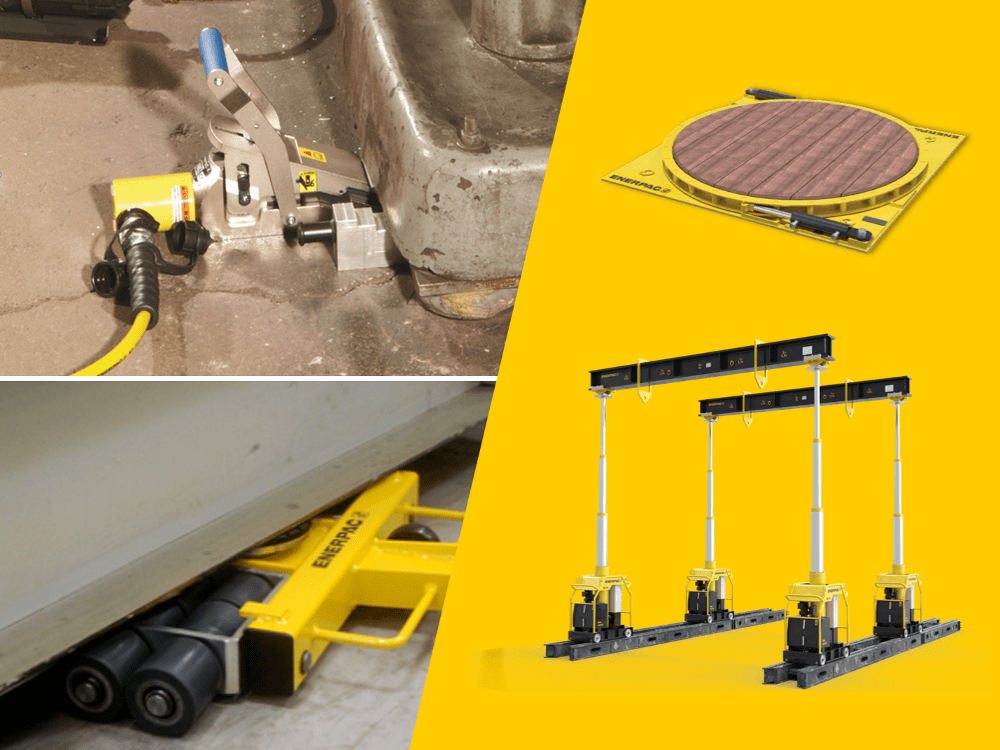
They enable precise vertical lifting with limited horizontal positioning (via track systems or skid movement), making them ideal for handling heavy components such as transformers, generators, large UPS modules, and prefabricated data centre skids. Their controlled lifting capability is particularly valuable during assembly, maintenance, or relocation within constrained factory areas.
Automated Guided Vehicles (AGVs)
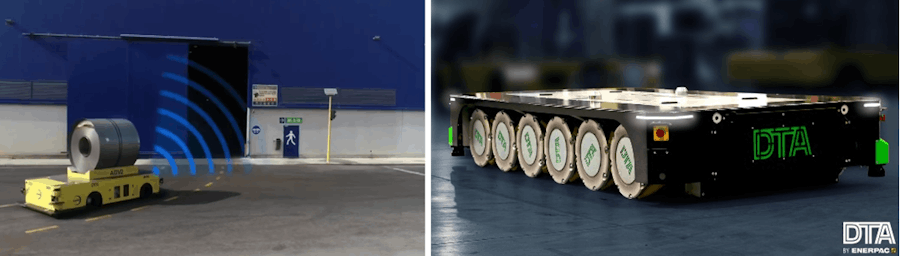
AGVs enable automated transport of heavy loads along predefined routes within manufacturing facilities. They are best suited to repeatable workflows, such as moving components between assembly stations or to test areas.
Typical data centre applications include transport of battery strings, UPS modules, cooling units, and other palletised or skid-mounted equipment. While they offer smooth and consistent movement, their use for extremely high loads (e.g. large transformers or generators) is generally limited compared to heavier-duty transport systems.
Navigation methods include magnetic tape, embedded wire, laser guidance, vision systems, and LiDAR-based SLAM (Simultaneous Localization and Mapping). GPS may be used for outdoor transfers between buildings.
Self-Propelled Electric Transporters (SPETs)
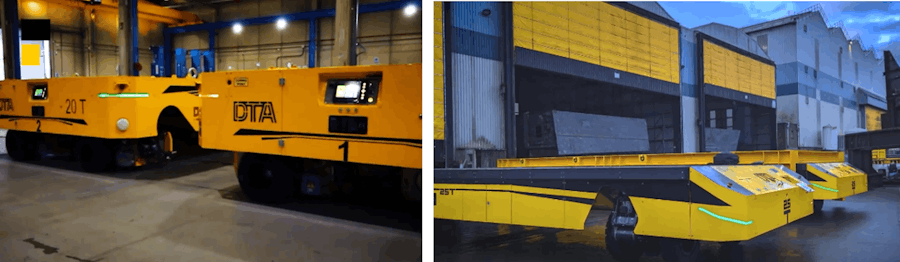
SPETs are designed for transporting extremely heavy and oversized loads and are commonly used for moving generators, transformers, and fully assembled data centre modules.
Their modular axle configurations distribute weight effectively, making them suitable where floor load limits are critical. Multiple units can be linked and operated synchronously to handle very large or irregular loads.
Advanced steering modes provide exceptional manoeuvrability in tight manufacturing environments, while wheel material selection is important for protecting finished factory floors.
Powered Machine Skates
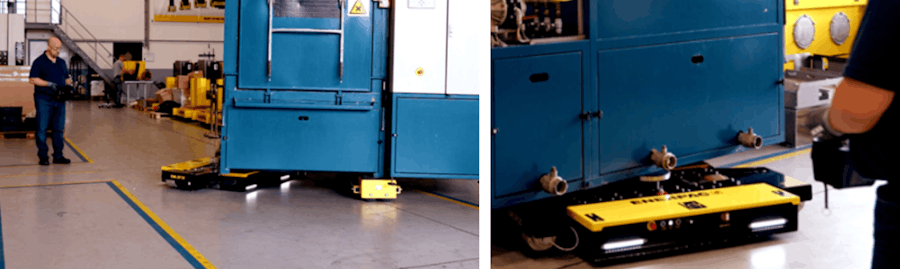
Battery-powered machine skates offer a compact remote-operated solution for moving heavy equipment over relatively short distances, particularly in space-constrained areas.
A typical configuration includes one powered unit with follower skates, allowing controlled movement of loads such as UPS frames, switchgear line-ups, and smaller skids.
Rail-Guided Vehicles and Electric Trolleys
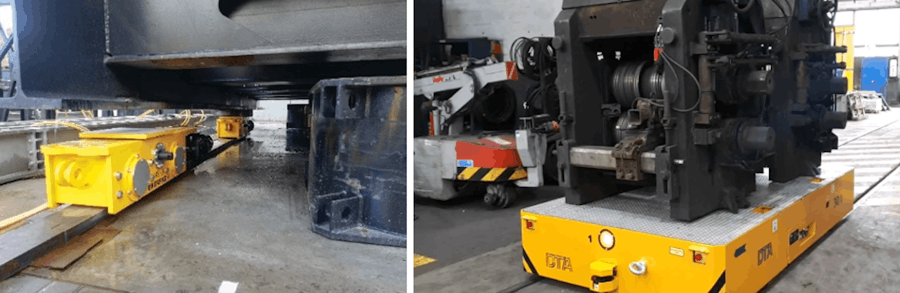
For high-frequency, repeatable movements, rail-guided systems and electric trolleys provide a robust and predictable transport solution along fixed paths.
They are well-suited to production-line environments, for example, moving generators, cooling skids, or modular assemblies between fabrication, testing, and dispatch areas.
Incremental Lifting Systems
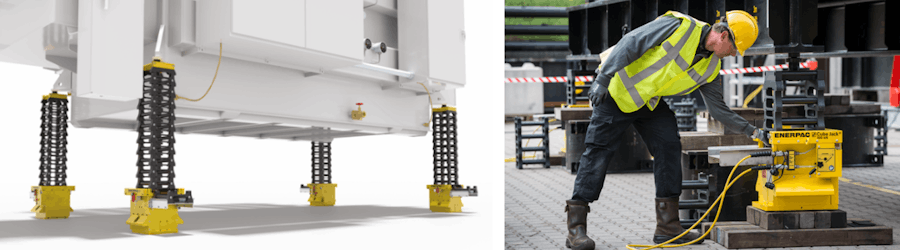
Incremental lifting systems (jack-up systems) use controlled lifting and engineered cribbing to raise loads in stages from below.
They are particularly useful where overhead lifting is not feasible, such as lifting transformers, generators, or modules into position within restricted spaces. These systems prioritise stability and control rather than speed.
Below-the-Hook Synchronous Hoists
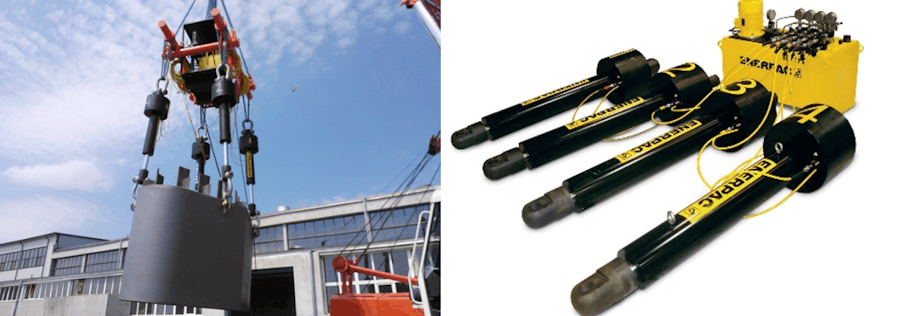
Where an overhead crane is available but greater control is required, below-the-hook synchronous hoists provide coordinated lifting from multiple points. They ensure even load distribution and minimise tilting, making them suitable for handling large, uneven, or high-value assemblies such as transformers, generator packages, and prefabricated modules.
Multi-Point Lifting Systems
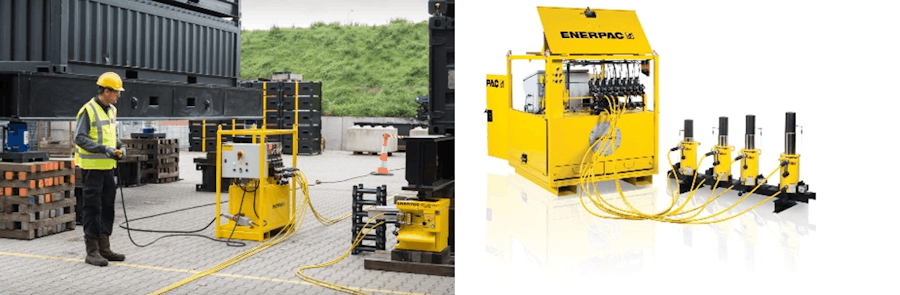
Multi-point lifting systems use a synchronised hydraulic pump to lift and position loads evenly across several lifting points. They are typically applied to large structural assemblies and modular units where maintaining alignment and structural integrity is critical during lifting, positioning, or installation.
Faster Throughput Without Expanding Your Facility
By implementing the right heavy equipment handling solutions, manufacturers can transform their operations:
- Increased throughput across production and dispatch
- Reduced congestion in staging and load-out areas
- Lower risk of damage to finished, high-value equipment
- Improved safety during final handling and transfer
- Faster, more reliable delivery timeline
Most importantly, these solutions allow manufacturers to scale output without major infrastructure investment.
Heavy Equipment Handling Solutions to Keep Up with Data Center Growth
As demand accelerates, success depends on more than production capacity. It requires seamless movement from the first lift through to final dispatch.
Selecting the right handling method depends on load characteristics, movement frequency, facility constraints, and total cost of ownership. OEMs and procurement teams should evaluate not just lifting capacity, but also repeatability, infrastructure requirements, and risk exposure across the full production lifecycle.
Ask About a Customized Movement Plan
With a custom-engineered movement plan, you’ll get a clear path forward to more streamlined product handling. Our expert engineers will develop a tailored plan for your application – complete with technical specifications, layout guidance, and optional CAD visuals.